Posted: 6/3/2026
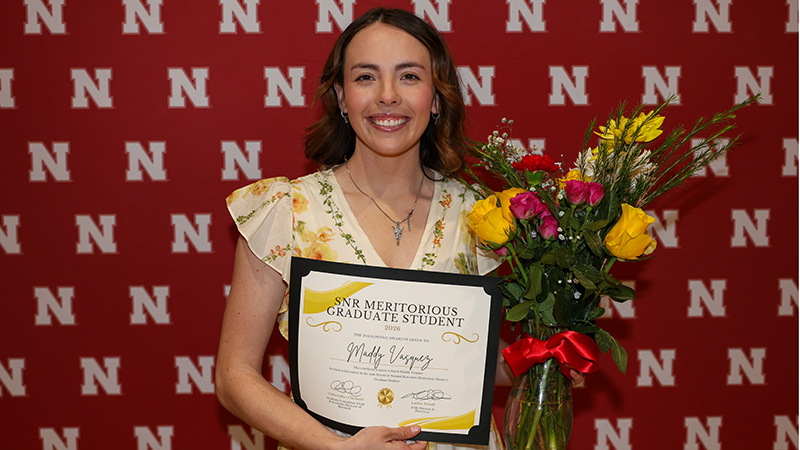
Vasquez wins master's student award in School of Natural Resources
By Ronica Stromberg
As Maddy Vasquez listened to awards being called out at the School of Natural Resources spring banquet last year, she thought about how cool the Graduate Student Meritorious Award was for a master's student.
"I was like, 'Wow, I would really like to win that someday. I hope I do enough to warrant that award.' And then I got that this year," she said.
The award notification came as a surprise, arriving by email while she was talking with her research partner, Ava Britton, and one of their advisors, Mark Vrtiska. She told them she thought she might have won the master's award, and they confirmed that they, and all of her labmates, already knew that.
"I started tearing up," she said. "I'm like, 'Oh my gosh, oh my gosh, oh my gosh,' and then I started running around in a circle."
The whirlwind experience didn’t end there, as she was able to invite her parents to the spring banquet and see their joy when the award was announced. She also saw Britton, her best friend in college, win a surprise award, the Joe Gabig Memorial Award. It's an award given by the Nebraska Chapter of The Wildlife Society, normally at a banquet in February or March. This year, though, the chapter moved to a fall banquet and asked the School of Natural Resources to announce the award for them.
"That one was a complete surprise, and I'm like, 'Oh my god, we won awards together!' It was such a magical moment," she said.
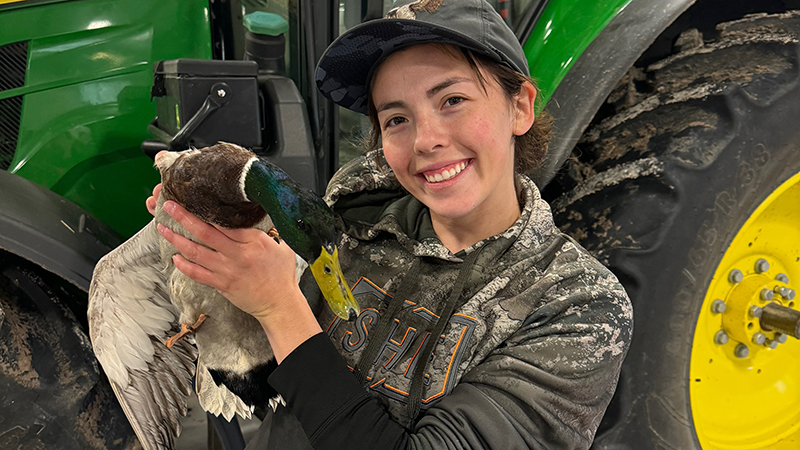
The two have been working together under the guidance of Vrtiska and Chris Chizinski, professors in wildlife management. They have been studying the results of the two-tier duck hunting regulation that Nebraska and South Dakota recently implemented. In the original duck hunting regulation, Tier I, hunters could harvest six ducks a day but the ducks had to be of a specified species or sex. In Tier II, hunters can harvest three ducks a day without species or sex restrictions.
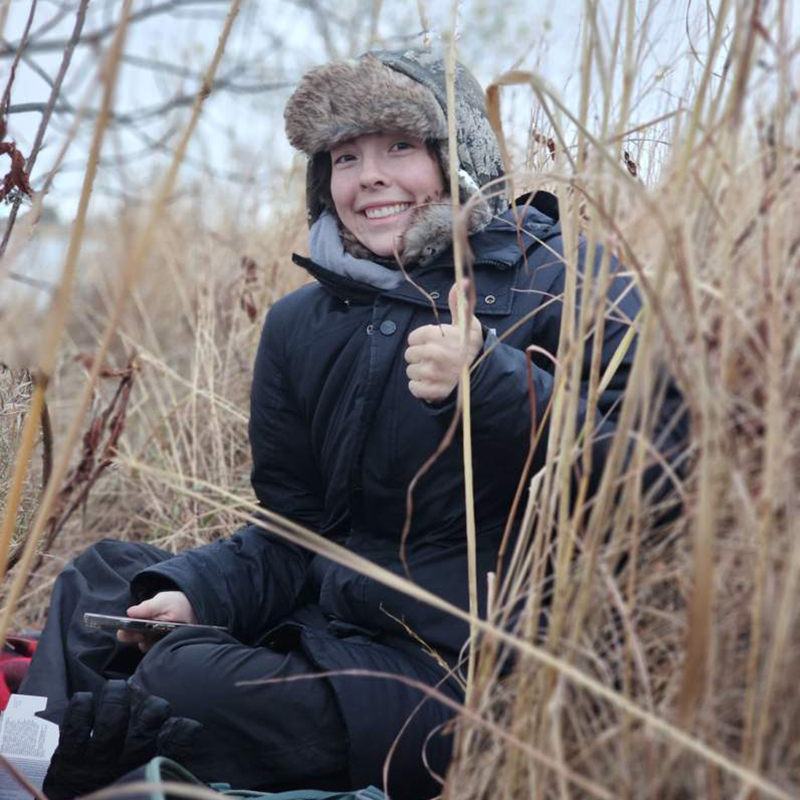
Vasquez has been focusing on the hunters and their motivations, satisfaction and the way they learn. Other states may adopt the Tier II regulations depending upon what she and Britton find.
Vasquez has been preparing to graduate this December with a degree in natural resource sciences and an emphasis in applied ecology. She said she hopes to then earn her doctorate and continue in academia because she likes to teach. She has been teaching an ecology lab with undergraduate students.
Originally from Omaha, Vasquez came to Nebraska from Bellevue University, where she earned her bachelor's degree in biology. She had volunteered at Omaha’s Henry Doorly Zoo and Aquarium throughout her childhood. She said she had always loved animals but not so much birds after one dropped on her in fourth grade.
She had to set aside the memory of this fourth-grade fiasco when seeking to join a wildlife project and being offered a place on the team for the duck research. She said her thinking about birds changed after doing research related to them.
"I've grown to learn to not only love birds but ducks specifically," she said. "They're fascinating little creatures."
Vrtiska said the work she has done on the project and her enthusiasm and passion made her deserving of the award.
"She has just immersed herself into not only her research project but the concept behind her thesis project, the assessment of two-tier duck hunting regulations," he said.