Posted: 4/23/2026
SNR Alumni: Ryan Powers returns to Nebraska with wildlife career
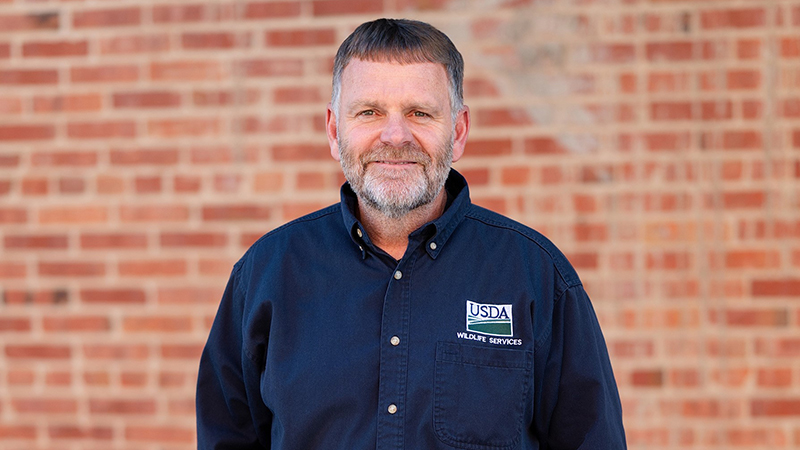
By Ronica Stromberg
While others envision wildlife careers involving quiet communes with nature, Ryan Powers' wildlife work involves propane cannons, unmanned aircraft systems and pyrotechnics.
The district supervisor for the USDA Wildlife Services in McCook, Nebraska, Powers started working in wildlife damage management shortly after graduating from the University of Nebraska–Lincoln with a fisheries and wildlife degree in 1996. He has worked in eight states, responding to calls from farmers, ranchers, agencies, airports, cities and others for help dealing with wildlife wreaking damage or disease.
Whether its birds flying in the paths of planes at airports or airbases, coyotes preying on cattle, beavers undermining a railroad embankment, migrating blackbirds decimating a farmer's sunflower fields or a slew of other wildlife problems, Wildlife Services is the one to call for a solution.
Powers had wanted to be on the receiving end of that call even back in college, but when he graduated, Wildlife Services had more applicants than positions. He took work on a whitetail deer project with South Dakota State University, worked for the Kansas Department of Wildlife and Parks on a wild turkey project, helped the University of Nebraska-Lincoln with elk research in the Pine Ridge and did fisheries work with the Department of Environmental Quality in Lincoln.
He persisted in applying for Wildlife Services positions, and in 1998, landed one with the USDA Wildlife Services at Whiteman Air Force Base near Warrensburg, Missouri. The work he did for this joint program of Missouri, Iowa and Minnesota mainly involved scaring birds and other wildlife off the airfield to reduce hazards to the B-2 Stealth Bomber.
"It's kind of ironic in the sense that, when you go to college for wildlife biology, your goal is usually to enhance wildlife habitat to support wildlife populations," Powers said. "But in this sense, we're making recommendations to make airports and airbases less attractive to wildlife so that you don't have them utilizing the airfield. The goal is to reduce wildlife-aircraft hazards."
Within a year, he transferred to a Wildlife Services office in Iowa and worked five years on issues like livestock predation, wildlife damage at grain facilities and beaver damage.
When Wildlife Services started the National Wildlife Disease Program in 2003, he headed to North Dakota as a wildlife disease biologist. He worked there for 13 years, helping deter wildlife diseases and foreign animal diseases from spreading to U.S. livestock and wildlife.
He eventually became a district supervisor in the Dakotas and, in 2024, applied for and received a district supervisor position in Nebraska not far from his hometown of Trenton. He now supervises all the Wildlife Services field personnel in Nebraska. The move to administration pulled him away from doing as much fieldwork, which he noted as a natural progression for some in the wildlife field.
"In most entry-level positions, you're the boots on the ground, you're doing a lot of field-related projects, you're working outside, you're directly involved with cooperators, and you’re using all the wildlife management tools and techniques you learned in college," he said. "But then, at least for some of us, there comes a point in your career that you want more responsibility and are ready to accept new challenges, so you enter into a supervisory position, which pulls you away from getting to do the fieldwork, and now you're doing more administrative work."
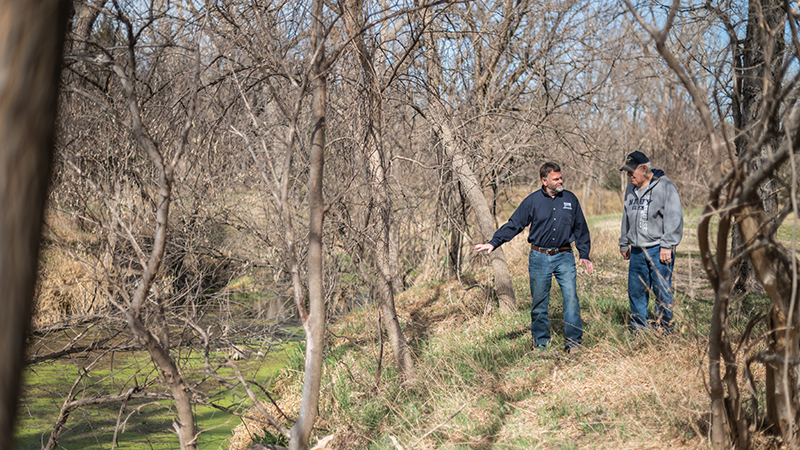
He still gets to do what he said he has enjoyed the most in his career, helping people solve wildlife problems.
"You hear it time and time again from a lot of cooperatives and stakeholders that talk about they would be put out of business if they didn't have an agency that was there to help them solve some of these wildlife-related problems," Powers said. "So, that's probably what I find most rewarding is that when we're able to alleviate wildlife damage for our cooperators and bring them some relief."
In Nebraska, typical wildlife issues he and his staff deal with are coyotes preying on livestock, beavers flooding crops and damaging roads and railways, prairie dogs damaging grasslands, European starlings eating and contaminating livestock feed and birds infringing on airports or other businesses.
For students interested in such work, he advised developing contacts with agency supervisors and staying in touch with them to communicate strong interest. Instead of hiring interns, Wildlife Services hires recent graduates for term appointments. These 13-month, entry-level positions give new hires experience in the field. The positions can be extended yearly for up to four years before the position is reannounced.
The Wildlife Services program has had more job openings recently compared with when he first entered the workforce, Powers said. These may be in newer programs like the National Wildlife Disease Program, the National Feral Swine Damage Management Program, the National Rabies Management Program or the Wildlife Biosecurity Assessment Program.
When such jobs are counted along with openings at state agencies, Powers said there are more entry-level positions than students wanting to take them. He encouraged recent graduates to take entry-level positions even if the positions don't exactly match what they want to do for a career. The positions can benefit them, he said, by giving them experience and awareness of other career opportunities.
In Nebraska, they may find themselves working with Powers, who said he has been happy to reunite with family in the McCook area and plans to stay.
"When you graduate from college, even from high school, you're eager to go out, find yourself, develop your own career, and just do your own thing, but then, later in life, I think you reflect upon things a little bit more, and you find yourself wanting to return to where you started," he said. "And so, it seems like I've come full circle. So, I fully anticipate that I will probably finish my career in Nebraska."