Posted: 1/26/2026
Powell pens book about changing Nebraska landscapes

By Ronica Stromberg
Larkin Powell brings 20 years of research in Nebraska to fruition in his seventh book, "The Best of Intentions: A Story of Landscape Change in the Heart of the Great Plains."
"It is a history of our landscapes, which in Nebraska means that it's a history of agriculture, for the most part, and how agriculture changed over time that impacted landscapes," he said before a book talk on January 23 at 3:30 p.m. to 60 people at the University of Nebraska–Lincoln.
The director of the university's School of Natural Resources, Powell published the softcover book through the Nebraska Maps & More store in Hardin Hall. He included photos, journal entries, old advertisements, maps and family stories to show the role humans played in changing the state’s land from prehistoric times to modern day.
Michael Forsberg, a conservation photographer and author who previewed parts of the book draft, said he was eager to get the finished book based on what he had already seen.
"What I know is Larkin's book is an extension of himself: honest, clear-eyed and accessible," Forsberg said. "It speaks volumes to our relationship with the land that we call home here on the Plains. What Larkin has lived and learned and cared about most of his life, from his farming roots in Iowa to his research as an ecologist to his decades as a teacher and now as the director of the school, are all poured into this book. And the research that he did to find all the illustrations is amazing."
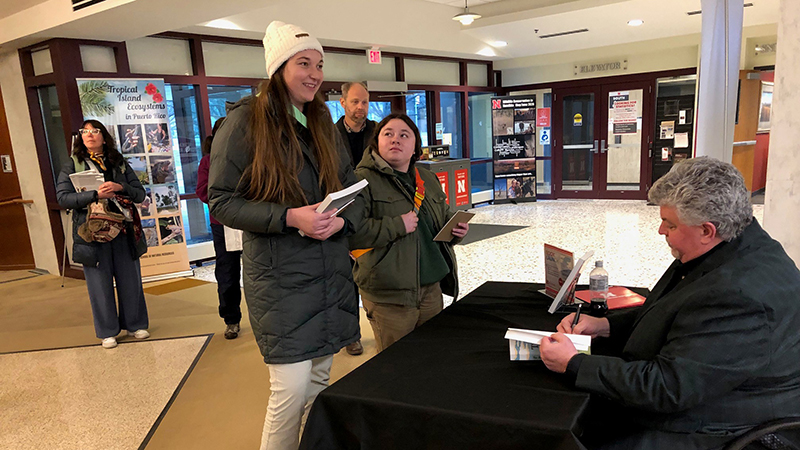
Powell started writing the book in the early 2000s after a meeting in Scottsbluff where a resident asked him questions about Nebraska’s history, like when the state's last wolf was removed. Powell had moved to Nebraska from Iowa four years before and realized through the questions how little he knew of the state's history or wildlife. He began seeking answers at the state's historical societies and museums in off-hours and eventually traveled to the National Archives and Library of Congress in Washington, D.C. At such stops, he collected the newspaper clippings, photos and journal entries that he later put in his book to show readers the real people whose lives formed this story.
The book identifies threshold moments for change like the removal of Native Americans from the land to reservations; European settlement of the land with the Homestead Act; farm bills started in the Great Depression; innovations of World War II like fertilizer, insecticides and mechanization; increased exports and emphasis on productivity in the 1970s with the opening to global markets; and food science innovations in corn and soybeans that increased their popularity in the 1990s as main crops.
Powell comments in the book that while people may have launched many of the changes or innovations with the best of intentions, they discovered drawbacks later. Fertilizer polluted streams. Insecticides like DDT and chlordane caused health problems. The list goes on, strumming an oft-repeated lesson.
"There is, through the history of it, this idea that sometimes we go for short-term advantage without thinking about longer-term repercussions," he said.
Having grown up on a small farm in Creston, Iowa, Powell brings to the book an understanding that farmers and ranchers need to profit from their land. As a wildlife biologist, he also voices a need to keep grass on Nebraska land for wildlife. He examines ways that people have historically worked together with fewer tools than those available now to overcome problems on the land, like stopping flooding by building terraces with only shovels.
"If they could do that, surely we can work together to create ways to design our landscapes to impact some of these issues, like nitrates and things that are a bugaboo for our society at the moment," he said.
Katie Nieland, the associate director of the Center for Great Plains Studies and designer of the book, said the book offers an important perspective to regional decision making.
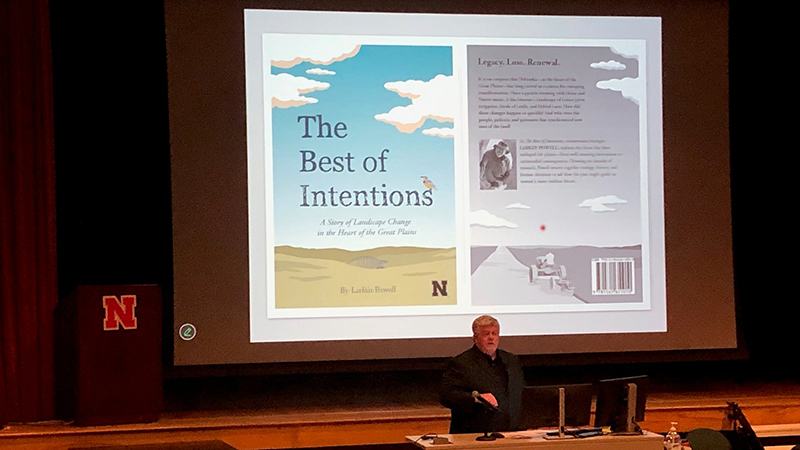
"To make decisions about our region in the future, it's important that we understand how we got to this place, and this story does that," she said. "Powell's voice and the stories he chooses to tell give both a big picture of the region but also a personal one, delving into his family's history as farmers."
Powell said he hoped the book would spark and guide conversations and noted how working on it changed his own life.
"Personally, probably through the process of doing this, I got a lot more attached to Nebraska than I was before," he said. "Just knowing some of the stories and seeing photos and other memorabilia increased my pride in the state, and there's emotion in the book too. Some of that is my attachment and desire to make sure that good things happen for the future of this state that my family has lived in 24 years and now call home."
"The Best of Intentions" is available for purchase for $26 from the Nebraska Maps and More Store on the first floor of Hardin Hall, 33rd and Holdrege streets on East Campus. The book can also be purchased online at https://go.unl.edu/bestofintentions and amazon.com. To place an order by phone, call 402-472-3471.