Posted: 2/6/2026
Student documents new homeowners on campus: flying squirrels
By Ronica Stromberg
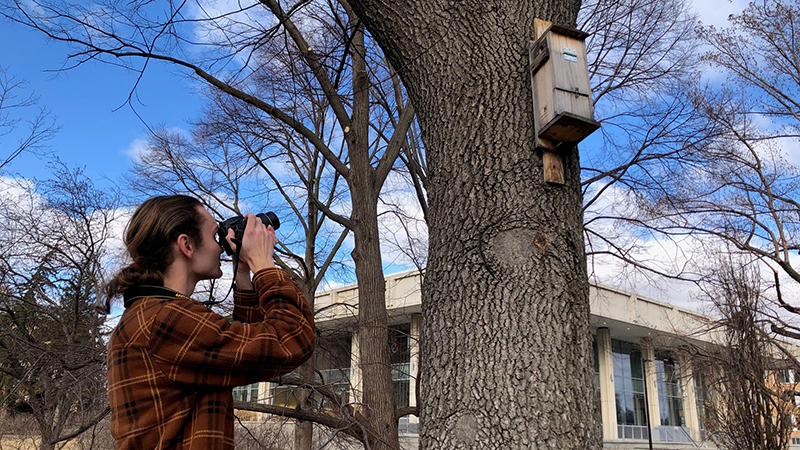
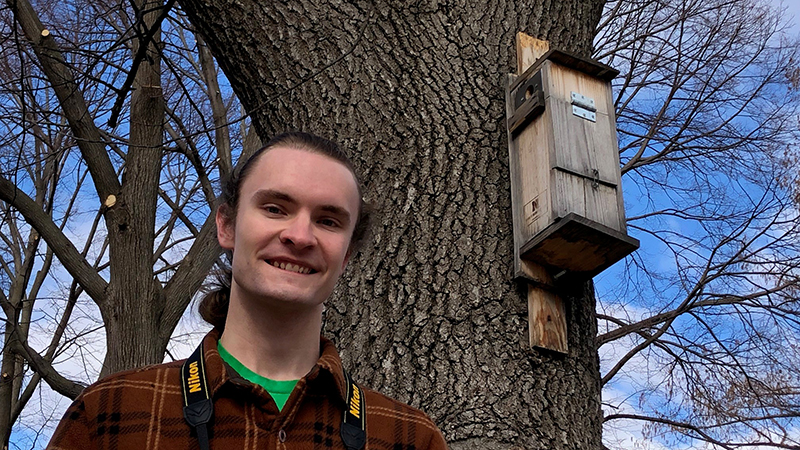
Josh Palik looks forward to one day sighting endangered whales, but at the University of Nebraska–Lincoln, the fisheries and wildlife senior recently made a rare sighting of another sort. He was taking photos on East Campus for a journalism class when he spotted a southern flying squirrel, a threatened species in Nebraska.
Palik had a digital camera in hand and was looking for a flower or another plant with symmetry to photograph for class when he looked up into a tree about 15 feet away and saw a tiny squirrel with large eyes. This was not one of the gray or black fox squirrels commonly seen scampering around campus. Palik began shooting photos.
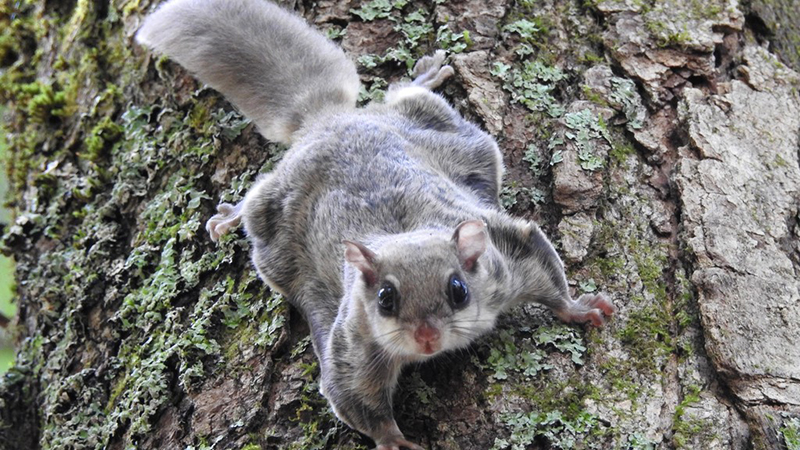
He had heard how, in 2021, the landscape crew on East Campus had filmed a southern flying squirrel gliding down from a tree. Before that, the squirrels were thought to be living only in the southeast part of the state, along the Missouri River. John Carroll, professor of wildlife ecology and management, said the only specimens in the state museum came from Nebraska City around World War I.
The 2021 appearance of the gliding rodent—they don't actually fly—had caused a sensation in the School of Natural Resources. Not every day does a rare species show up at your doorstep for observation. Following the sighting, the school launched a Lincoln Flying Squirrel Squad with the surrounding neighborhood and Calvert Elementary School. Its Nebraska Maps & More Store brought in flying squirrel-themed T-shirts and stuffed animals for sale. The school received a Nebraska Watchable Wildlife Grant from the Nebraska Game and Parks Commission and built nesting boxes for the new neighbors to live in.
And then the nocturnal critters seemed to disappear into the night. Scientists climbed ladders to the nesting boxes and found a few twigs and leaves in them but where were the squirrels? Sightings were few and far between and lacked photographic evidence.
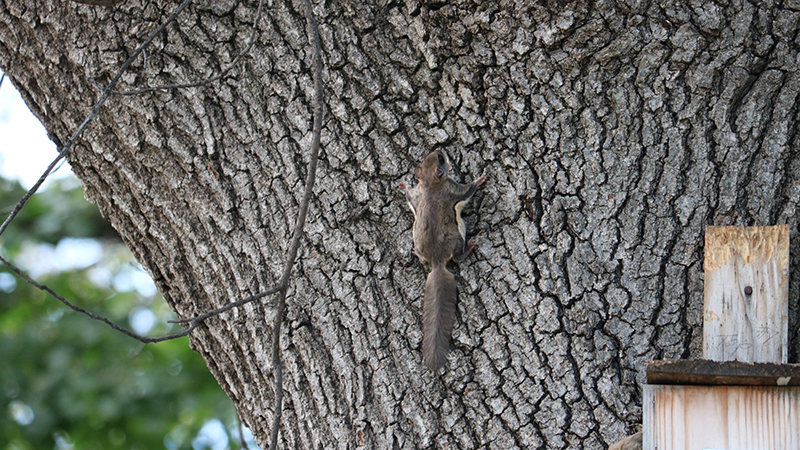
Palik's footage proved worth its weight in acorns because it caught not only one southern flying squirrel but two—and they were using one of the nesting boxes. First one squirrel was outside the box on a tree near the Maxwell Arboretum. The second squirrel stood inside the box, poking its head out. Then the two traded places. With their superhero capes stretching from wrist to ankle, the pair could rival squirrels on a Mark Rober obstacle course. In the 20 to 30 seconds they spent outside the box, Palik snapped five photos of them.
The photos didn’t meet the criteria of his journalism assignment but drew acclaim from professors in the School of Natural Resources and students in the school's Wildlife Club.
"That was the first confirmed record of southern flying squirrels using one of our campus boxes," Carroll said. "I was pretty excited."
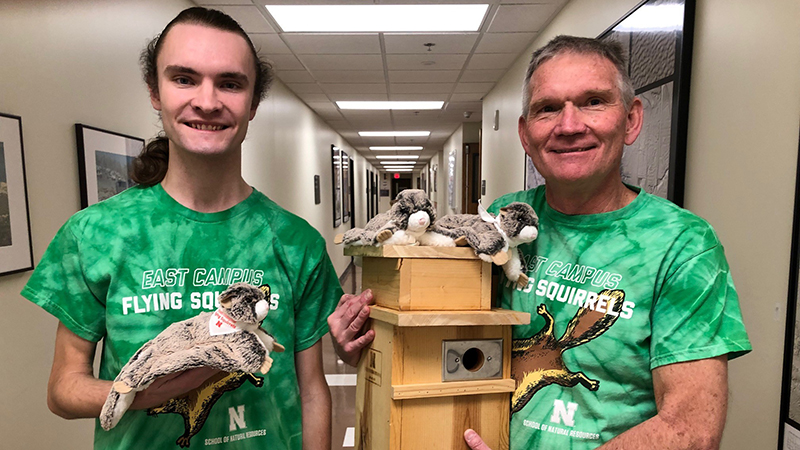
Carroll, students from the Wildlife Club and others had set out 15 boxes since 2021, but he said it often takes time for birds and mammals to figure out how to use them. Flying southern squirrels typically live in tree cavities, but trees with cavities often have decay and are removed from campus for safety.
Carroll and Hannah Hahn, a senior fisheries and wildlife major, are surveying all the boxes and plan to install three more. Carroll said they will also add trail cameras to two boxes that evidence squirrel use. Short of a midnight squirrel patrol, the trail cameras may be the best opportunity to spy the gloaming gliders.
Palik acknowledged he was lucky to see the rare squirrels in daylight, around 1 p.m. Of course, they weren’t whales—which would really be something to see in Nebraska—but he said his main interest in wildlife has always come from a conservation standpoint.
"As far as I can remember, I've just always really wanted to protect nature, and I love nature a lot," he said.
His rare squirrel sighting and documentation didn’t alter his plans to study whales in graduate school, but it did change one thing.
"I do look up at the boxes whenever I walk by, because I'm like, 'Maybe I'll see them again,'" he said. "But I haven't seen any since then."