Posted: 5/8/2026
Wildlife professor and club place bat house on East Campus
By Ronica Stromberg
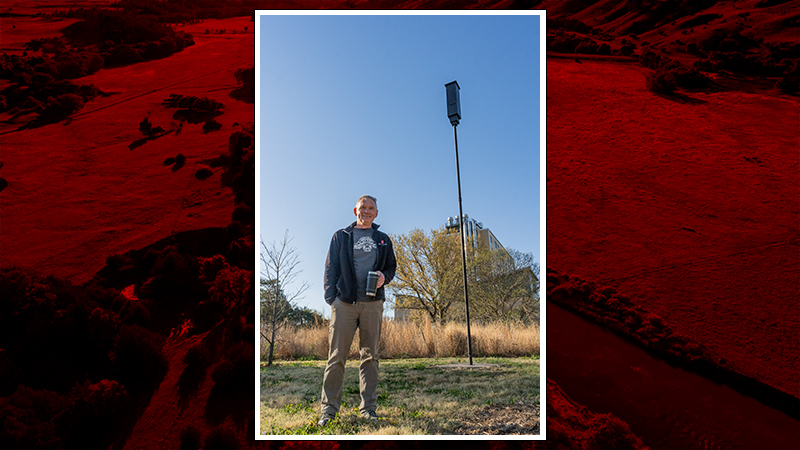
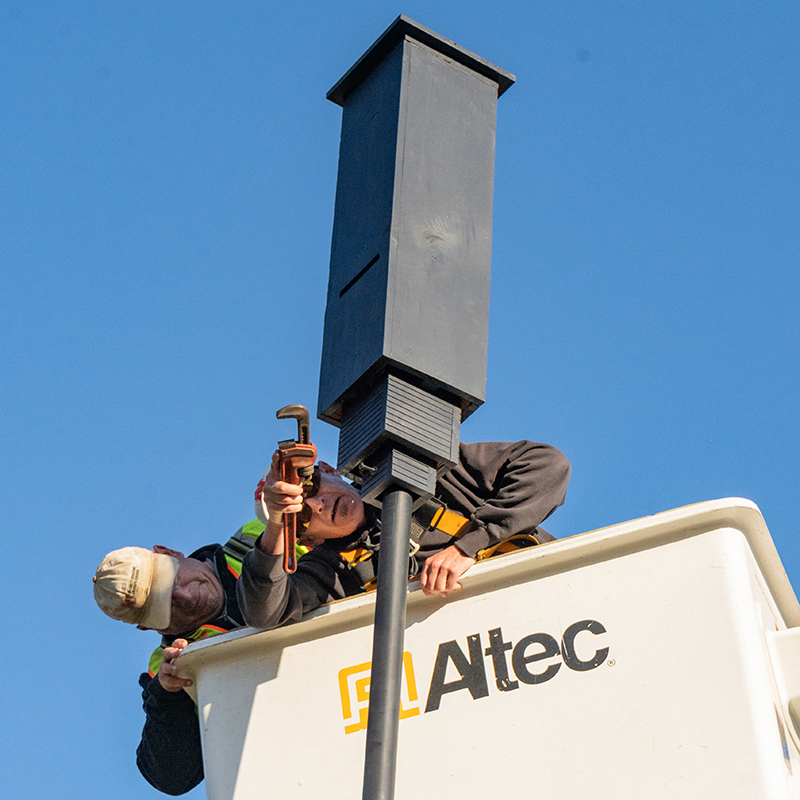
The skies over the north lawn of Hardin Hall just got a little friendlier toward bats with the addition of a bat house. John Carroll, professor of wildlife ecology and management, led a dozen students from the University of Nebraska–Lincoln Wildlife Club in building the bat house. A crew from the university’s Landscape Services installed it on a pole 20 feet above ground on April 16.
Carroll and Joe Kouba, president of the Wildlife Club, presented the bat house to the School of Natural Resources community at the school's Earth Day celebration on April 21.
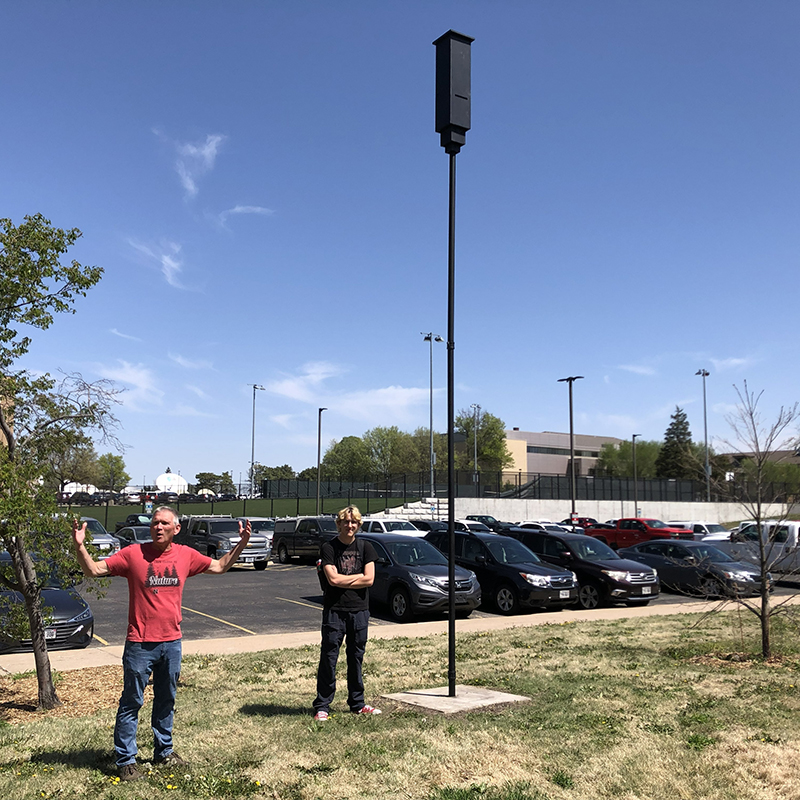
The bat house joins birdfeeders, birdhouses, a tower for chimney swifts and patches of lawn converted to prairie at the school. Carroll said the addition of the bat house was one part of a 12-year effort to enhance the school property by providing habitat for wildlife and giving people the chance to conserve and observe it.
"We're the environmental school at the University of Nebraska," he pointed out. "Our north lawn was, for a lot of us in the school, a bit of an embarrassment, because it was just another big mass of mowed lawn. And so, we were like, 'OK, it's a big enough area where we could make it some multiuse facility that is a nice place for people to be, makes the campus more welcoming, instead of just an ugly lawn, and at the same time, serves some educational purposes, which it's already doing.'"
Forestry instructors use the north lawn's trees to teach students how to safely climb and work in trees. Undergraduate students use the birdfeeders in research projects like looking at which wild birds eat different kinds of seeds. Carroll and students monitor flying squirrels boxes they have placed around East Campus.
Kouba said the bat house will serve to educate those who are unaware about why bats are important as well as being a marker to let natural resources students know they can make a difference in helping wildlife. He said students readily volunteered to help construct the bat house, with Carroll teaching them to use power tools and follow a Bat Conservation International design.
"The club was excited about the idea to create something important to be present at the school for years to come," Kouba said. "I think everyone loved the idea that they could play a part in making it happen."
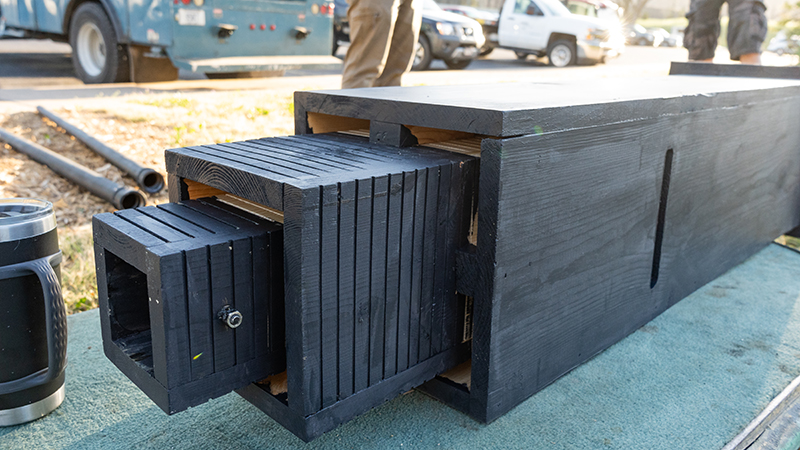
The bat house has an inner set of four compartments and weighs about 50 pounds. Landscape Services securely fastened the streamlined box to a pole set in concrete so it would not be taken by strong Nebraska winds. Carroll said attaching it to the school was not an option and they wanted to keep it away from trees where hawks could easily pick off bats exiting or entering the outer box.
The box can house several hundred bats, which in Nebraska, would likely be big brown bats, the most common species here. Little brown bats, which are endangered by a disease called white-nose syndrome, also live in Nebraska but would be unlikely to roost in the same box as big brown bats.
Nebraska has few caves and forests, where bats naturally live. Carroll said they hope the bat house will provide habitat other than people's attics because people generally don’t want bat noises and smells in their homes. He makes smaller bat houses to attach to a shed, barn, garage or underside of a deck. Wildlife students sell them to people interested in furthering biodiversity in urban areas while keeping down mosquito populations.
Whether Carroll or others in the wildlife community place more bat houses on campus may depend upon how well this first one is received, he said.
"With the squirrel boxes, it was pretty easy, because everybody thinks flying squirrels are cute, but bats, it might just take a little bit more education," he said. "People get used to seeing stuff like that, and then they realize it's not some kind of spy equipment, and I think that they'll go, 'Yeah, it's kind of cool seeing the bats go in and out of the house,' and I think that people will embrace it."
He has already formulated a possible next step in wildlife plans for the north lawn with Dennis Ferraro, the school's herpetology professor. He said they would like to dig a 30-foot-wide pond at a depth of up to two feet for frogs and toads.
Kouba noted that providing habitat for bats and other wild animals at the School of Natural Resources is a way for humans to give back to them.
"We as humans have taken away so much habitat and space for wildlife to live," he said. "By providing structures like a bat box, we can help support the wildlife around us. In doing so, we can all become more connected to and learn to coexist with the natural world that we are a part of."